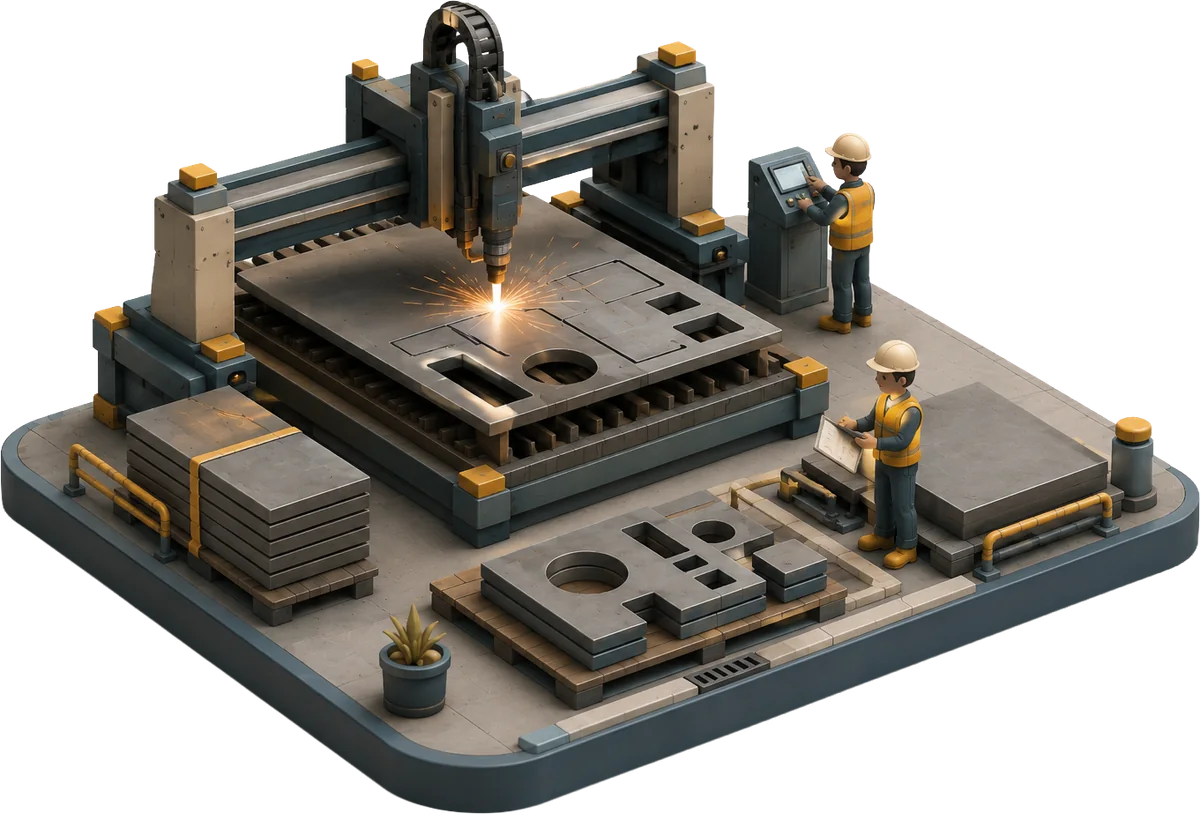
Every part knows its plate. Every drop keeps its value.
Burning, beveling, and forming with every part traced to its heat, and remnants back in stock with real cost on them, not scrapped off a whiteboard.
Every cut leaves a drop worth tracking.
Most systems can't hold a remnant, so it sits unlabeled until someone scraps it, and you reorder steel you already own.
Burn a few parts off a plate and the usable remnant needs to go back to stock with its heat and its cost. Most systems lose it, so you scrap steel you paid for and reorder what you already own.
The heat number has to transfer at every cut, or the part can't prove where it came from. On pressure vessel work, a part without its paper trail isn't a part. It's scrap with labor in it.
The customer needs the MTR for every part on the truck. Compiling the pack by hand from filing cabinets burns hours, and it happens on every shipment.
Mill price, freight, tariffs, and the burn all land in different places. Averaged cost can't say what this part cost, so margin on processed work is a story you tell yourself.
This is what Fion fixes, from the mother plate to the last drop.
One plate, every part, and the drop.
Modules built for plate
Every module in Fion understands plate natively: thickness, grade, heat, and remnant. Here's how they map to your operation.
Track full plates and usable drops by thickness, width, length, grade, and heat. Remnants return to stock automatically after every burn, carrying real cost.
Learn moreWork orders for oxyfuel and plasma burning, beveling, forming, rolling, and drilling, with remnants returned to stock, costed.
Learn moreBuild quotes against live plate and remnant inventory filtered by grade, thickness, and size. Allocate exact pieces, and the margin you see is the margin you'll get.
Learn morePOs carry the whole purchase cost, customs and duty included, and route for approval. Receive against the order, and every vendor charge lands in one queue, checked against what you expected to pay.
Learn moreBuild shipments from the ready-to-ship queue, generate the BOL, and capture the driver's signature at completion.
Learn morePurchase, freight, and processing build up on every plate and part, piece by piece. Invoices post in batches to your accounting system.
Learn moreRunning plate with Fion vs. without
- Drops scrapped or tracked on a whiteboard
- Parts that can't prove their heat
- Cert packs compiled by hand for hours
- Tariffs and freight lost in a catch-all account
- Margin on processed work guessed from averages
- Drops return to stock automatically, costed
- Every part traced to its mother plate and heat
- The MTR pulled from the piece in seconds
- Duty and freight land on the plate they rode with
- Margin from what the part actually cost
Common questions from plate operations
Does Fion track heat numbers and MTRs through burning and forming?
Yes. Work orders track inputs to outputs, so every part cut from a plate traces back to the mother plate and its heat, and the MTR stays linked to the source plate. Pull the cert from any part in seconds.
What happens to drops and remnants?
They return to stock automatically when the work order closes, carrying their heat and a real cost. A drop is inventory you can quote against, not a whiteboard entry waiting to become scrap.
Does Fion do nesting?
No, and it doesn't try to. Your nesting software decides where parts go on the plate. Fion is the system of record for what went on, what came off, what it all cost, and where the drop went.
How does Fion cost a part?
Purchase price, customs, and handling are set on the PO and land on the material at receipt. Freight lands when the plate moves, and the burn and any outside services land at the work order. Margin is computed from the exact pieces allocated to the order, not an average.
Does Fion replace our accounting system?
No. Fion runs the operation and posts batched invoices to the accounting system you already keep, including QuickBooks, Dynamics, NetSuite, and Sage.